

A primary school in the west of Singapore has used Mangostin for NAPFA for several years. This was its first year using RFID timing for the Primary 4 and Primary 6 runs.
Across the two year groups, 13 classes used RFID timing: seven Primary 4 classes and six Primary 6 classes. The school organised the sessions with two classes running at a time on the same track.
Students carried their cards in their pockets, and four teachers managed each two-class session. There were also a few incomplete lap records per class. Teachers can record a lap on the spot in the Crew App if they see a student pass but the reader misses the scan.
This account is based on details and photographs shared by a teacher at the school.
Two classes at a time
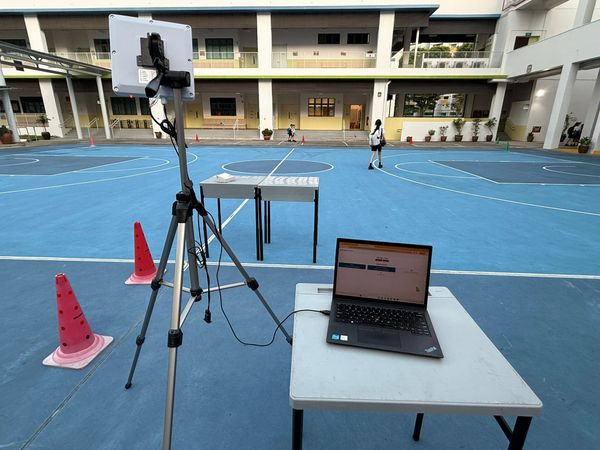
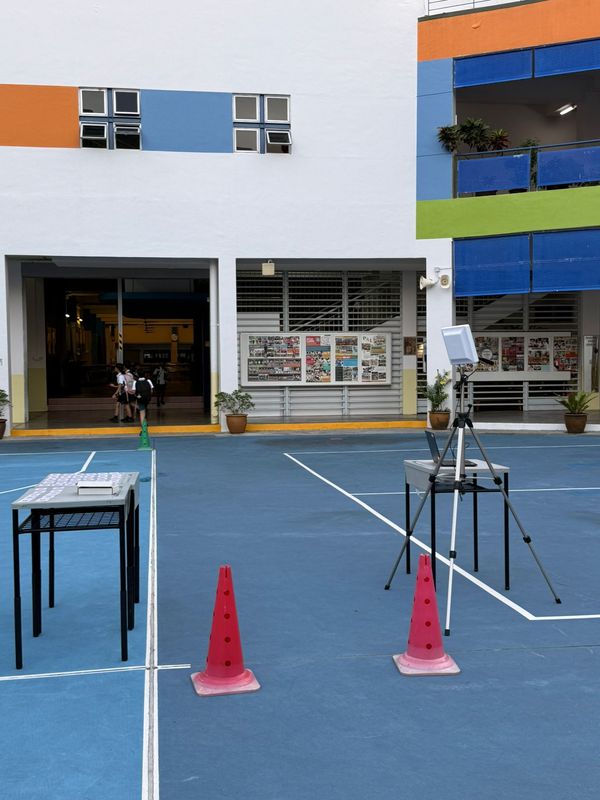
During a two-class session, both classes shared the running track, but teachers could follow their own class’s progress in Mangostin. Each class had a laptop connected by USB to an RFID reader on a tripod.
The two timing setups were about 10 metres apart in the parade square, where Wi-Fi coverage was good. For each class, the run started and finished at its own timing point.
Running hands-free, with cards in pockets
Schools have a choice about how students carry their RFID cards:
- Cards in pockets: students run hands-free, but need to pass the reader in disciplined single file.
- Cards in hand: students show their cards to the reader as they pass. Several students can cross together, within the reader’s range and capacity.
Mangostin’s usual recommendation is to carry the card in hand and hold it in front of the body or slightly above the head when passing the reader. This gives schools more flexibility in how students pass the timing point.
The school chose the hands-free option. Students kept their cards in their shorts pockets to avoid dropping them. Teachers used cones to guide them into single file past the reader. Passing one at a time was part of that choice, rather than a requirement for every RFID setup.
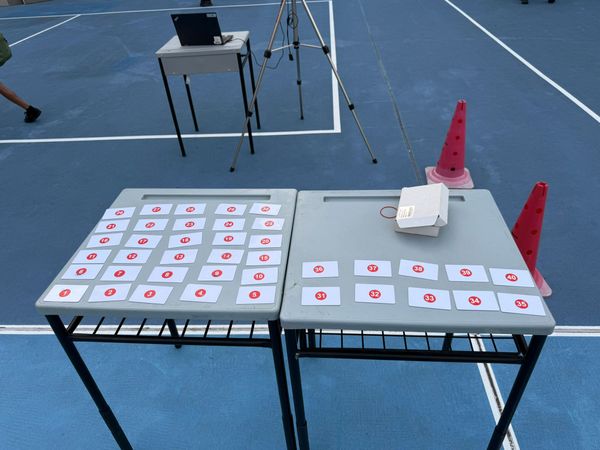
Before the run, students collected cards laid out on tables. The number on each card matched the student’s class index number.
From at least six teachers to four
According to the teacher, testing two classes without RFID required at least six teachers. With RFID, the school used two teachers per class: four teachers for a two-class session.
Teachers still needed to monitor students and watch for missed reads. The staffing comparison is for a two-class session at this school, not the whole cohort or a promised reduction for every school.
The teacher in charge believes that, with more experience using RFID, the school could use fewer staff per class at the next NAPFA test. That is an expectation for the next run, rather than a confirmed staffing plan.
Checking incomplete lap records
The teacher reported between one and six students per class whose records did not show all three required laps.
That figure is not a count of missed RFID reads. Some reads were missed, but some students also stopped before completing the run. The cause was not established for every incomplete record.
Teachers needed to check the records against what they had observed. An incomplete record does not, on its own, show whether a student missed a scan or stopped running.
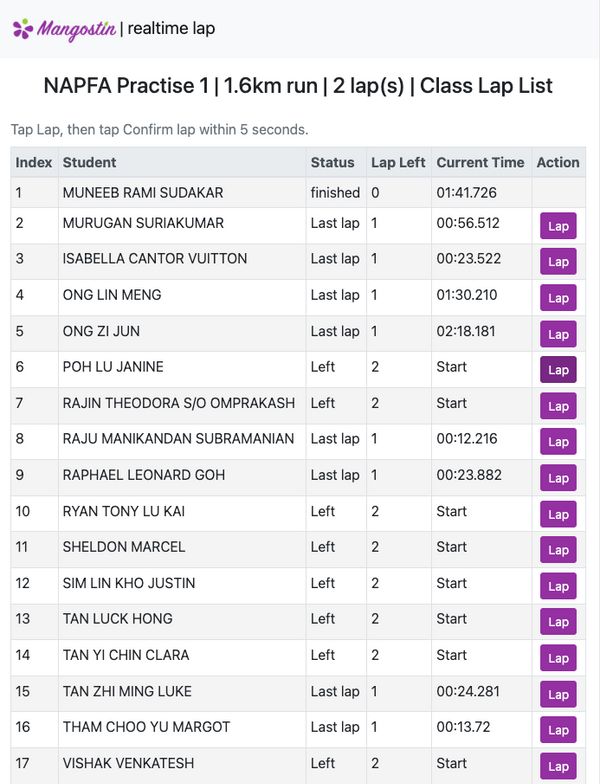
When a teacher sees a student pass but the reader misses the card, there are two ways to record the lap on the spot:
- In the Class Lap List, find the student, tap Lap, then Confirm lap within five seconds.
- In the Crew App’s timed activity, tap the student’s name tile, then submit Lap / Finish.
These actions record a teacher-observed pass at the time of the manual action. They do not automatically reconstruct the exact time of an earlier missed read.
During this first year, the manual fallback was not consistently used. Familiarity with the Class Lap List and the Crew App’s lap-recording controls is one area to build on before the next NAPFA test.
The school’s first year with RFID shows the practical choices schools need to make: how to run classes together, how students carry their cards, and how teachers respond when a lap is not recorded. Before the next run, teachers can practise the manual recording options and decide who will watch for missed reads.
See how Mangostin supports NAPFA score recording, RFID run timing and sharing results.